Image courtesy of Dale Development
A high-profile site in Amesbury is a test case for a resurgence of a housing style that consumes less land and takes a smaller bite out of household budgets.
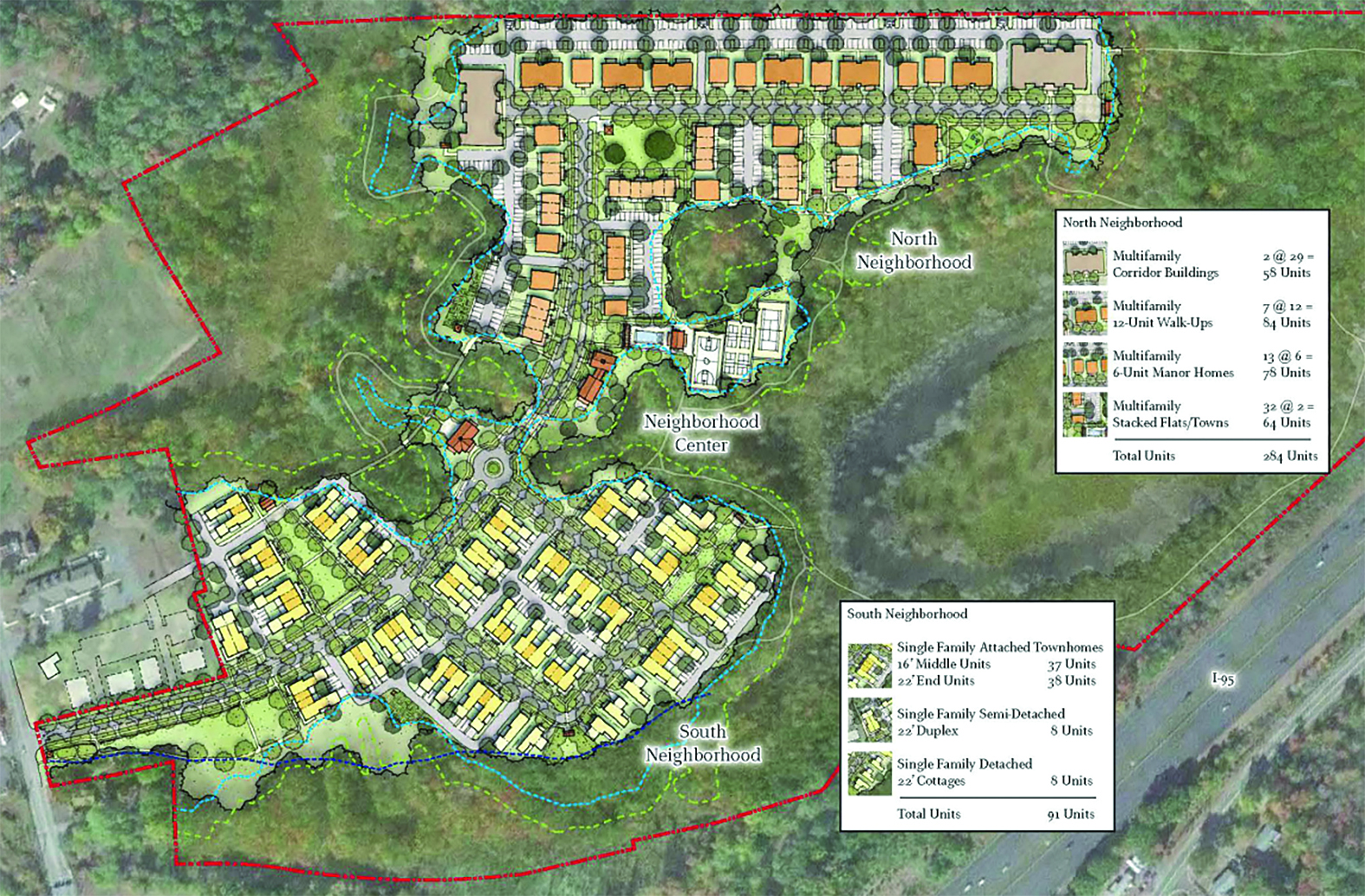
The Rocky Hill development in Amesbury will demonstrate a modern-day model for cottage-style housing.
“Most builders would tell you they prefer not to do large homes any longer,” said Bob Dale, a New Hampshire developer who is nearing final approval for a 379-unit project. “People aren’t looking for the maintenance of the big yard, and it would be extremely appealing to builders and easier to get away with a lot less infrastructure costs.”
Inner suburbs with small house lots carved up before modern zoning are largely built out, minimizing the opportunities for new construction, said Amy Dain, a senior fellow at the Boston Indicators think-tank at The Boston Foundation. Further from Boston, many communities have large minimum lot sizes, encouraging developers to build luxury-sized homes to recoup their investment.
“This law would create a lot of opportunities for subdividing larger lots and building more single-family homes as infill across the region,” Dain said.
Legal tools like the state’s Chapter 40B law, which lets developers go around Massachusetts towns’ zoning if a project contains 25 percent affordable housing or more, already give developers leverage to push back with an alternative to large lot subdivisions, such as cottage homes.
Dale Development originally planned to use Chapter 40B to develop the town’s most prominent site: the Golden Triangle located between Interstates 95 and 495 on the New Hampshire border.
Amesbury officials subsequently included the site in their MBTA Communities zoning district, complying with the state law that requires 177 cities and towns to allow multifamily development near public transit.
The 64-acre Rocky Hill development proposes 379 housing units, including apartment buildings, townhouse-style buildings and 10 cottage-style homes, which will be offered for sale.
Dale said the mix of housing mix, which includes 83 for-sale units and the remainder rentals, was determined through discussions with town officials. The project is undergoing a site plan review, its final local approval, and is expected to take three or four years to build out, Dale said.