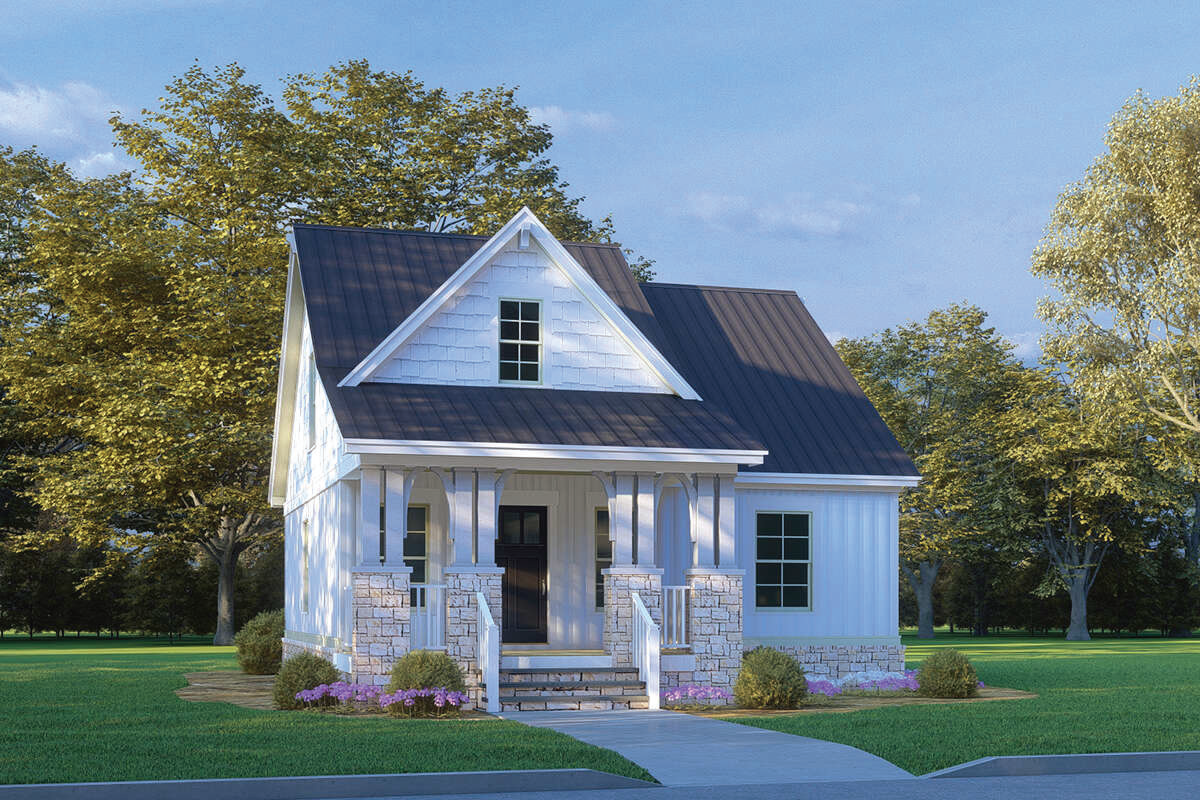
Developer Mike Guitard’s planned 0 Court St. “cottage court” development has 30 homes on 9.5 acres of land on the outskirts of central Keene, a short distance from the city’s hospital. Image courtesy of Guitard Homes LLC
A new housing trend is emerging in New Hampshire that could lead to increased construction of badly needed “missing middle” homes that fit the needs of both downsizers and first-time homebuyers.
In recent years, a number of communities across the state have passed so-called “cottage courts” zoning initiatives that allow the building of more densely packed single-family homes or townhouses on smaller lots of land. The goal: to provide smaller, more affordable housing options for would-be buyers priced out of today’s real estate market.
Among the communities that have passed or considered “cottage courts” ordinances, or similar higher-density zoning initiatives, are Lebanon, Antrim, Bedford, Hinsdale, Londonderry, Hampton, Milford and Harrisville, according to state officials and real estate industry executives.
Perhaps the most famous example of a cottage court-like project in New Hampshire is the Cottages at Back River Road in Dover, where developers Maggie and John Randolph have built about 44 “tiny homes,” each ranging in size from 384 to 444 square feet.
But the city of Keene has quietly emerged as a leader in the cottage court trend, having already approved four major projects totaling 85 units since passing its new Cottage Courts Overlay District in May 2024.
An additional 16-unit project on Howard Street in Keene is in the early stages of planning and consideration, according to city officials.
1.25K SF Homes on Small Lots
Under Keene’s cottage court rules, single-family homes must “average out” to 1,250 square feet each – meaning some units can be slightly bigger than the average if they’re offset by smaller units – on a land footprint of no more than 900 square feet per unit, excluding porches and garages.
The footprint for each townhouse unit is also restricted to 900 square feet; a duplex building’s footprint is limited to 1,800 square feet.
All of Keene’s cottage court units must be connected to existing city sewer and water lines – and the overlay sets a maximum amount of parking at one space per bedroom.
Unlike some other cottage court guidelines around the state and country, Keene’s rules do not require shared open and common-area spaces.
And all of the Keene units are allowed to be sold at market prices.
The developer of one of the already approved Keene projects – which includes 29 single-family homes on nearly 10 acres of land on Court Street – hopes to sell his newly built, smaller houses for $299,000 to $399,000 each, depending on their individual sizes.
Those prices – reflecting the smaller 716-, 1,250- and 1,394-square-foot sizes of the planned homes, without additional garages and sheds – are considerably less than the statewide median price of $510,000 for a single-family house in New Hampshire.
Inspired by ‘Old-School’ Neighborhoods
Mike Guitard, owner of Guitard Homes LLC, said he expects to start construction on the Court Street project later this year.
“The spirt of cottage courts [housing] is really about old-school neighborhoods,” said Guitard, referring to classic close-knit housing subdivisions that used to be regularly built decades ago.
“It makes sense. Most people prefer to have a stand-alone home 30 feet away from another house, rather than staying in a shared living-space buildings [like condo and apartment complexes],” he said.
But will the smaller homes/more-dense housing projects actually work from a developer’s financial standpoint?
“I don’t know yet,” said Guitard. “I won’t know until I build and sell these units. We’ll have to see how it goes.”
In theory, the higher density/smaller homes combination should work, due to the efficiencies gained by building multiple units on smaller lots, rather than constructing only one house on 1-, 2- or even 5-acre lots, as many towns now require around the state, said Guitard.
In addition to the savings on land costs, cottage courts efficiencies are gained via lower costs for materials and infrastructure like roads and sewer/water hookups, he said.
Keene Needs 1.4K New Homes
Jay Kahn, mayor of Keene, said the new cottage courts overlay rules represent a “significant effort” by the city to construct more desperately need attainable housing.
According to a recent study, Keene is estimated to need about 1,400 new housing units in order to meet current and future demand, Kahn noted.
“What we wanted was something that would encourage more infill development around the city – and we think cottage courts will help with that,” he said. “They offer a residential option that currently doesn’t exist.”
And Evan Clements, a planner and zoning administrator in Keene, said the city hopes to approve additional cottage courts projects.
“We’re hungry for more,” he said. “We think it’s an awesome tool to maximize one lot [of land]. cottage courts let us do both large and small projects. It’s very flexible.”
He emphasized that cottage courts are not by-right ventures in Keene. Each development proposal must win conditional-permit approvals from the city’s Planning Board before construction can proceed.
NH Not the First to Try Them
Industry experts say the concept of cottage courts – also known as “cottage clusters” and “pocket neighborhoods” elsewhere around country – have been around for a while.
But only in recent years have they begun to gain limited acceptance across New Hampshire and the country.
“It’s definitely a trend,” said Nick Taylor, director of Housing Action New Hampshire, a nonprofit housing advocacy group. “People are starting to look at cottage courts more closely. Keene is definitely doing a lot of them – and they’re starting to attract attention as a result.”
Taylor noted that cottage courts are similar to so-called “cluster subdivisions,” which also allow homes to be built closer together on smaller lots. But cottage courts homes are typically smaller in size than most subdivision homes, he said.
Via the New Hampshire Housing Finance Authority, the state is issuing grants to communities that want to explore cottage courts and other higher-density housing opportunities.
Keene was among those that got such a housing grant, said Sarah Wrightsman, manager of community engagement and education at NH Housing.
“It’s a housing option that seems to work well in our communities,” said Wrightsman of cottage courts and similar higher-density housing initiatives.
“It’s targeting that ‘missing middle’ of the housing market. It’s a great solution for many people. Keene is definitely at the forefront of the trend. They’ve done great work,” she said.