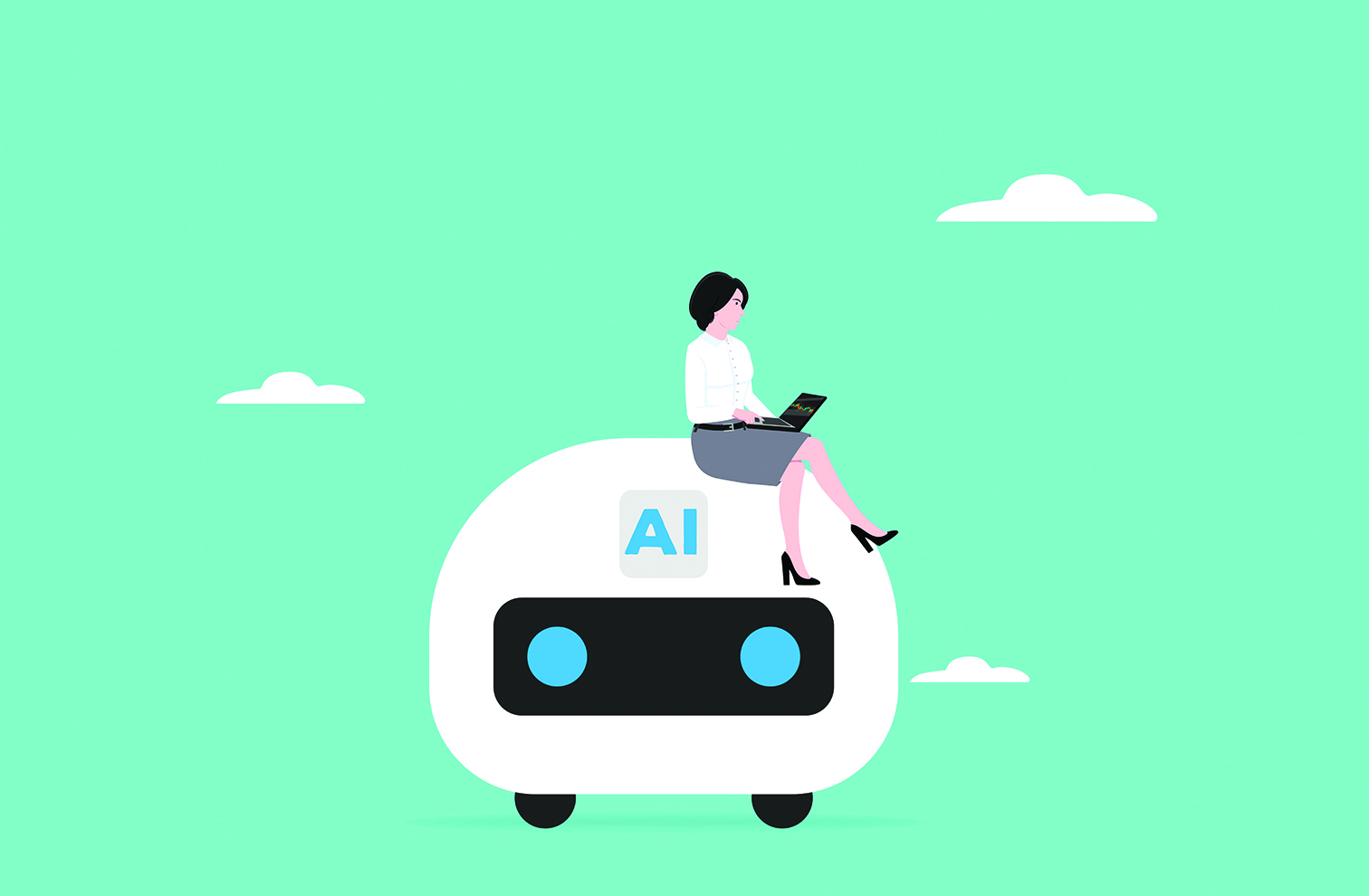
New Hampshire bankers say they’re being very slow and careful about adopting AI, unlike many other sectors in the business world. iStock illustration
New Hampshire banks are gradually and guardedly starting to integrate AI tools into their back-office operations amid concerns over customer privacy and security.
Bank executives and others stress that financial institutions are now only in the early stages of adopting various AI tools, often using popular AI models such as Microsoft’s CoPilot, OpenAI’s ChatGPT, Anthropic’s Claude and Google’s Gemini to enhance their already existing processing and other back-office platforms.
Among other things, AI tools are being used for data analytics, anti-fraud measures, summary reports, customer-contact centers and various automation processes already in existence at institutions.
“We’re just beginning to look at ways that banks can use AI and explore its capabilities,” said Jim Kisch president and CEO of Passumpsic Bank and co-chair of the Financial Services & Insurance sector of the New Hampshire AI Task Force, organized by the NH Tech Alliance to help local for-profit and nonprofit institutions adapt to the AI revolution.
Kisch, who is acting as the unofficial point-person for the state’s banking industry regarding AI-related matters, said it’s so early in the AI revolution that banks and third-party financial-service vendors are still trying to develop the AI tools and best practices necessary to move forward with AI products.
“There’s a desire for the banks to cooperate and learn from one another,” said Kisch, who regularly talks to industry colleagues about AI issues at roundtable events around the state. “We’re all starting with a limited amount of exploratory projects under a great amount of prudence and security.”
Banks Face Trust Gap
Jennifer White, managing director of banking and payments intelligence at JD Power, agreed that banks around the country are only in the preliminary stages of tapping into the potential of AI.
“They’re starting to use AI for things the average consumer doesn’t see,” she said. “Many consumers are not aware of the work banks are now doing with automation and AI.”
Bank consumers may not be aware of the specific behind-the-scenes use of AI by their financial institutions – but that doesn’t mean they don’t have opinions and even fears about AI, White said.
According to a recent JD Power survey of bank customers, nearly 27 percent said they’re already starting to use AI tools on their own to help better manage their personal finances.
But 37 percent said they don’t use AI tools for such purposes and an equal number of respondents said they’re worried about potential AI “mistakes” that could impact their funds and credit, White said.
“There’s a genuine fear among customers,” said White, referring to AI tools making potentially bad financial decisions. “But I wouldn’t use the word ‘fear’ so much as the word ‘trust.’ Many customers don’t quite trust AI yet.”
Among customers’ concerns: AI programs having access to their accounts, AI potentially publicizing sensitive personal financial data, and AI models having final say on credit-related matters.
Humans in the Driver’s Seat
Bank executives say they’re aware of such concerns, and are actively taking steps to alleviate those and other worries.
“Never sharing certain [sensitive] things with AI models, that’s first and foremost,” said Fisch. “You want to make sure that staff can’t inadvertently send any high-risk information to a model and those kinds of things. Some are looking at this issue from a risk management perspective.”
Simon Griffiths, CEO of Camden National Bank, which bought Berlin-based Northway Bank last year, said the human component will never be subordinate to AI at his bank.
“I think that human [interaction] is really important to our business,” he said. “We still believe very strongly in relationships. We believe in conversations. We believe in ultimately having the final oversight. We have to make the decisions.”
The bank is keeping humans in the driver’s seat, said the Maine-based bank’s Renee Smith, the executive vice president and chief experience and marketing officer.
“We’re not letting the AI decide for us. We’re letting it guide and steer us in the right direction and give a better understanding. But it ultimately will not make the final decisions,” she said. “We’re protecting [all] the customers within our own sandbox.”
Camden National’s ‘AI Shark Tank’
At Camden National, AI is effectively acting as, among other things, an add-on to the bank’s Snowflake platform, the cloud-based data management tool that allows banks to store, process and analyze reams of bank data.
An internal Camden National committee, set up specifically to review the future of AI at the bank, recently came up with about seven recommendations on how AI tools might be integrated into operations at Camden, Griffiths said.
Two of those recommendations – dealing with collection and summaries of sales-team information and various process automation functions – were implemented at the start of this year, said Griffiths.
“We’ve started to build out our AI program,” said Griffiths, noting the bank’s early efforts were known internally as “our AI Shark Tank.”
Most Banks Watching and Waiting
Right now, third-party firms are starting to crank out new AI-related products for the banking industry, according to industry executives said.
But most banks are still sort of on their own when it comes to AI adoption, as they await development of new AI-related tools and best-practice recommendations, said Passumpsic Bank’s Kisch.
“It’s like an early internet moment, when you’d see so many new things emerging one after the other,” said Kisch.
“Everything is so new [with AI]. You don’t know who and what will be the last one standing at the end. We don’t know who will emerge with a new gold-standard [AI product] for banking. It’s still too premature.”
JD Power’s White said the current rollout of new AI uses reminds her of when banks first started to use mobile bank-deposit apps.
“It took years for banks to fully [adopt] mobile bank deposits,” she said. “It now seems we’re following a similar trajectory with AI – and it’s going to come at a faster pace. There are so many new AI options coming to the market.”