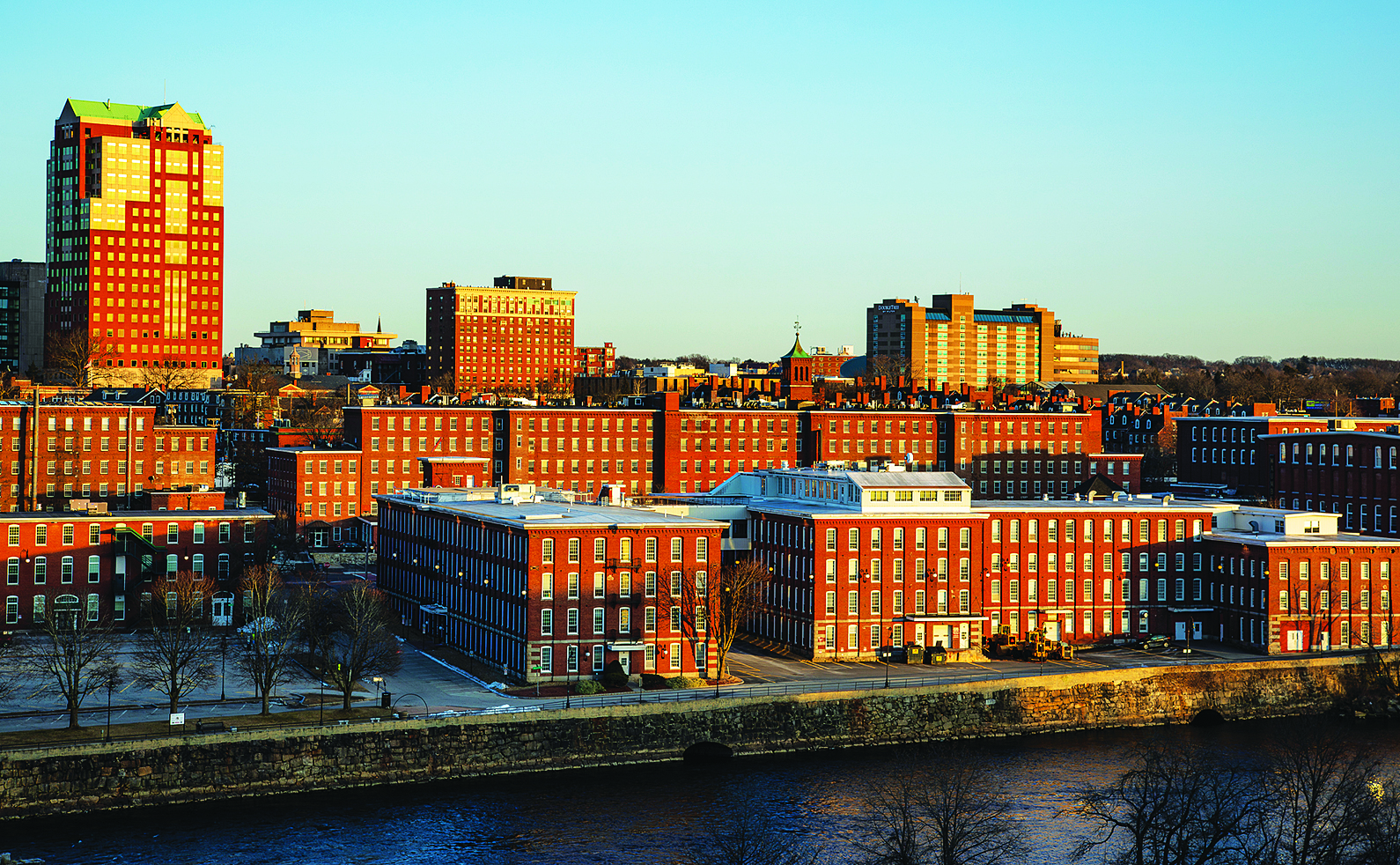
Downtown Manchester’s office buildings are seen in the evening sunlight. Market-watchers say ongoing projects to convert offices to residential in the city are helping manage the state of the New Hampshire office market. iStock photo
At first glance, the latest quarterly numbers tell a tale of a struggling industrial real estate sector and a recovering office market in New Hampshire.
But a closer look at all the numbers suggests something quite different is unfolding in the state’s commercial real estate world: an industrial sector adjusting amid ongoing strengths and an office market still trying to find its feet after taking devastating hits during and after the pandemic.
Recent reports by four commercial real estate firms confirm that New Hampshire, along with the rest of New England, continues to experience what some are calling a “bifurcated” CRE market in which industrial space continues to enjoy strong demand while offices grapple with multiple uncertainties.
“The 2026 commercial real estate market is increasingly split between outperforming growth sectors and those still recalibrating from post-pandemic disruptions,” declared a recent report from the Stubblebine Company, which specially pointed out the “bifurcated,” contrasting state of the industrial and office sectors.
In a recent report, Colliers International also noted the divergent courses of the two CRE markets – and the subsectors within them – over the past year.
“The New Hampshire office and industrial markets told two strikingly different stories in 2025,” Colliers researchers stated in a recent report. “New Hampshire markets are adjusting to new realities. Warehouse users seek smaller space while construction slows down. Manufacturers pursue upgraded facilities over new construction. Office tenants defer major decisions. The fundamentals have changed – and the market is responding accordingly.”
Let’s Do the Numbers
CRE observers emphasize that not everything is hunky dory in the industrial space – and not everything is doom-and-gloom for offices in New Hampshire.
As for industrial space in the state – which includes warehouses and mostly light manufacturing facilities – its vacancy rate has indeed been increasing of late, rising to about 6.5 percent in the first quarter, up 1.2 percent from the first quarter of 2025, according to Colliers.
The first-quarter vacancy rate is also significantly up from the 2.7 percent low set in 2022.
In all, there was net negative absorption of 224,000 square feet of industrial space in the first quarter in New Hampshire, according to Colliers.
Data from CoStar Group and Cushman & Wakefield show roughly the same industrial-space trends in the first quarter, compared to the first three months of 2025.
But a closer look at the data shows vacancy woes in the industrial sector are mostly due to the flood of new warehouse space into the market in recent years – with more than one million square feet of new space delivered in 2024 alone, according to Colliers.
In particular, warehouse construction, driven in recent years by robust demand from logistics and distribution companies, has slowed over the past 48 months.
But there was still 403,000 square feet of new space delivered in southern New Hampshire in 2025 – and another 550,000 square feet is expected to be delivered in 2026, according to CoStar Group.
In all, there’s about 775,000 square feet of new industrial space still in the southern New Hampshire pipeline, according to CoStar.
The bottom line: Although demand for industrial space has ebbed a bit over the past few years, it’s still strong enough to absorb more new space delivered to the market – and strong enough to demand slightly higher rents in the process.
‘Developers Remain Keen’
Indeed, industrial prices continued to rise in the first quarter, hitting about $12.31, up 4.3 percent over the same period in 2025, according to Colliers.
“Developers remain keen on southern New Hampshire,” CoStar recently concluded in its own recent report.
Kristie Russell, research director for Colliers in New Hampshire and Maine, said the industrial sector is in the process of rebalancing after a slight drop in demand and sharp rise in new supply delivered to the NH market.
Ultimately, the first-quarter numbers merely reflect an adjustment from a red-hot market to a more normalized market, she said: “It’s definitely not crashing.”
Among other things, there’s still particularly strong demand for industrial spaces of 20,000 square feet or less across New Hampshire, Russell noted.
Matt Giordano, associate director of analytics at CoStar Group, agreed that the industrial market in southern New Hampshire has been going through a rebalancing brought about by sector strengths, not sector weaknesses.
“The industrial sector was really white-hot post pandemic,” said Giordano. “It’s slowed a bit since. But demand is still very strong.”
As for the office market, it’s post-pandemic journey has been just the opposite of the industrial sector’s path – with a major plunge in demand due to the rise of remote work.
The dramatic fall in demand pushed the office vacancy rate from 7.5 percent in 2020 to 13.6 by 2023 in New Hampshire, according to Colliers.
As measured by the vacancy rate, the office market has seemingly stabilized in recent years in the Granite State, with the rate now hovering around 13.8 percent, according to Colliers.
Office Conversions’ Continuing Appeal
Lease prices have also remained relatively stable in recent years, according to data.
But the steady office vacancy rate and prices are partly due to the fact that 216,000 square feet of office space was converted last year to residential housing in New Hampshire, according to data.
In all, there’s been a 5 percent drop in overall office inventory since 2020 in New Hampshire, due mostly to office-to-residential conversions, according to Colliers.
And conversions will continue in coming months and years, particular in Dover, where Brady Sullivan Properties is planning to redevelop much of the old 585,000-square-foot Liberty Mutual office campus into residential housing.
Rob Rohrer, managing director of Colliers-New Hampshire, said it’s important to note that the office market is “not falling off the cliff” while the industrial sector is surging ever upward.
“The overall [CRE] market is more subtle and complicated than that,” he said.
But he said it’s clear the industrial and office markets have been on divergent paths for a while now – with office spaces continuing to struggle.
“There’s still interest in office space,” he said. “But we don’t see as much as we used to see. The market has changed.”