

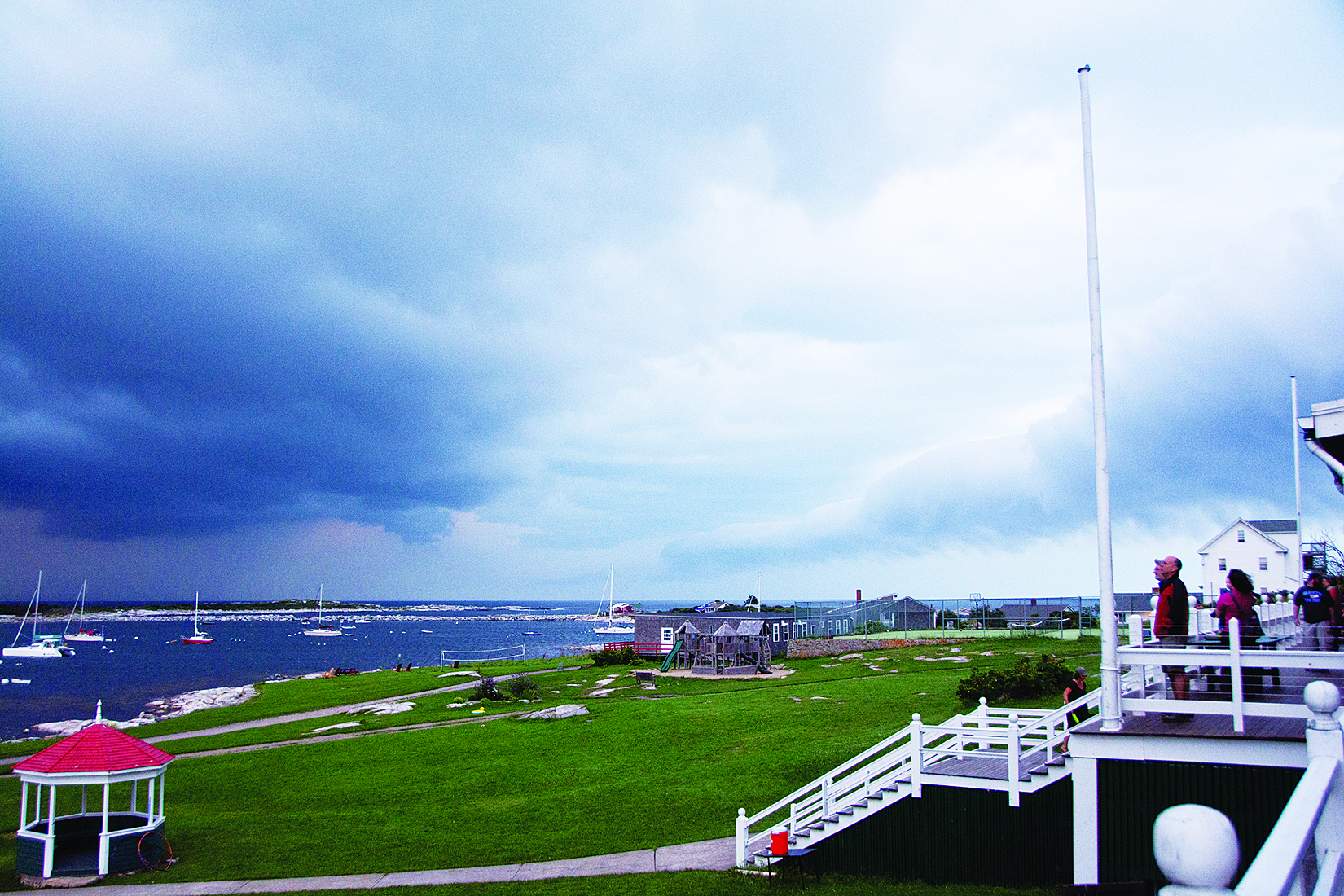
Storm clouds roll in over the Oceanic Hotel on the Isles of Shoals. Earlier this year, state legislators required sellers notify homebuyers about flood risks. But the most common tool – federal flood maps – don’t capture all the areas of New Hampshire that see frequent flooding. iStock photo
A new state law requiring that general flood risks be disclosed to potential buyers of homes is being hailed as a “step in the right direction” of greater transparency in the housing market process.
But the legislative sponsor of the new law and an estuaries expert say more needs to be done to better inform homebuyers of the flooding risks to their future properties amid growing fears of damage caused by climate change.
With little fanfare, the new state law was implemented across New Hampshire at the start of 2025, requiring that prior to the execution of a purchase and sale agreement that general flood risks be disclosed to a buyer by the home seller or seller agent.
The flood-risk warning is in addition to mandatory pre-sale disclosures about the potential risks posed by radon, arsenic, lead and PFAS (so-called “forever chemicals”) to properties or their residents.
Buyers must sign notification forms confirming they’ve been alerted to such potential risks.
But in the case of the new flood-disclose law, homebuyers are only warned of potential flood risks to coastal and waterway areas in general, not necessarily flood risks to specific properties that people are thinking of purchasing.
Industry Watered Down Requirements
According to the law, buyers are encouraged to “determine whether separate flood insurance is required and consult the Federal Emergency Management Agency’s flood maps (FEMA.GOV) in order to determine if the property is in a designated flood zone.”
Rep. Chris Muns, D-Hampton, sponsored HB 1320, the new flood-risk law passed in 2024. The law could have been tougher on flood-risk disclosures, he said.
Muns said he originally wanted to include in the bill a requirement that sellers disclose whether a specific property had previously experienced flood damage. He also said he wanted the new law to apply to large rental property sales, not primarily single-family sales.
The final bill ultimately excluded those provisions after various industry leaders expressed objections, Muns said.
“The original bill was quite a bit more extensive,” he said. “In the end, we accepted what we could get. In my mind, the [new law] is still an important first step” toward greater flood-risk transparency.
Abigail Lyon, assistant director of the Piscataqua Region Estuaries Partnership, part of a joint program by local, state and federal agencies to protect regional waterways, said she’s also pleased that lawmakers moved to warn future homebuyers of potential flood risks.
“It’s a small step in the right direction,” she said. “The law is a step closer to making buyers aware of potential flooding.”
But she agreed with Muns that it would have been better if HB 1320, as originally intended, required sellers to disclose if a specific property had previously experienced flood damage.
A similar law in Maine does require pre-sale disclosure of prior flooding incidents, she noted.
Flooding on Agents’ Radars, NHAR Says
Susan Cole, president of the New Hampshire Association of Realtors, said her group supports the new pre-sale disclosure law – and indicated notification forms distributed to NHAR members go above and beyond the law’s requirement.
She noted that NHAR-drafted notification forms encourage people to check off whether a property is “yes,” “no” or “unknown” to be an official federal-designated flood zone.
Sellers were already required to disclose potential radon, arsenic, lead and PFAS risks, so adding flood risks was not a problem, she said.
“It’s been pretty straightforward,” she said of implementing the new flooding disclosure provision. “It’s been seamless.”
She added that flood concerns have long been part of the purchase-and-sale discussion process, with many lenders requiring some buyers near coasts and inland waterways to secure flood insurance prior to getting a mortgage.
“Agents have been cognizant of this issue for a long time,” said Cole, owner of Susan Cole Reality in Lebanon.
FEMA Maps Don’t Show All Flooding
The issue of flood-risk disclosures across the country has been in the news recently after Zillow, the nation’s largest real estate listing service, removed an online feature that showed potential flood and fire caused by extreme weather tied to climate change.
Those future risks were based on climate-data modeling by First Street, a risk modeling company.
The New York Times, among other news outlets, reported that Zillow yanked the climate-risk feature after complaints from officials at California’s main Realtor trade group, who argued future flood and fire risks were hard to model accurately.
In contrast, FEMA flood zone maps aren’t based on First Street data and mostly focus on historic events for insurance standards.
Still, FEMA maps do change now and then – and some real estate figures interviewed for this story say both buyers and sellers have to regularly check to see if a property is in an officially designated flood zone.
The Piscataqua Region Estuaries Partnership’s Lyon agreed that FEMA flood zone maps do change, though not very often.
She added that FEMA has very specific criteria about what constitutes a flood zone – and thus it can omit from its zones areas of the state that regularly see flooding.
That’s one of the reasons why prior flood-damage disclosures are needed in New Hampshire, she said.
“There are people out there who don’t have flood insurance and probably should have insurance,” she said.
Disclosures Can Affect Price
Stephen Morrissey, a senior associate at East Key Realty in Francistown, said he supports greater flood-risk disclosure in general.
But he said disclosures can get tricky and contentious.
“FEMA maps are usually accurate, but there are instances where they’re not,” he said.
And that and other factors can lead to disputes over whether a specific property is in a flood zone or not.
Knowing that some people might balk at buying homes in officially designated flood areas, some sellers will pay thousands of dollars to conduct extensive land surveys in order to contest FEMA flood-zone boundaries, Morrissey said.
“Being in a flood zone can impact a sale price,” he said. “It won’t necessarily kill a sale, but it can impact prices.”

