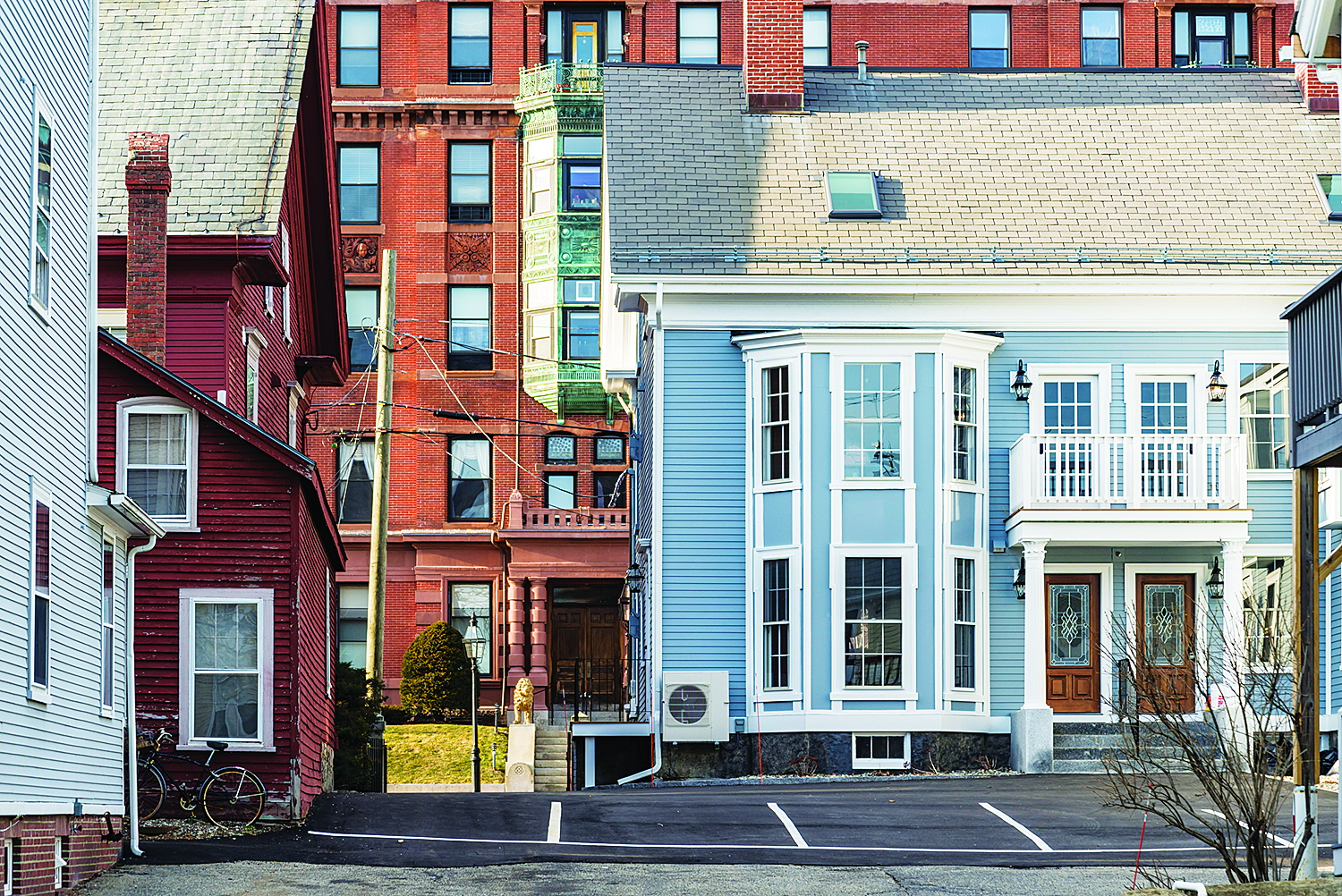
Apartments in Portsmouth. State, federal and private data all show New Hampshire multifamily construction is up despite the challenging financing environment of recent years. iStock photo illustration
Multifamily housing construction is gaining momentum in New Hampshire.
According to data from three different sources, construction of new multifamily housing is on the rise in key pockets around the state, providing desperately needed additional units amid a housing shortage that’s pushing home prices to ever higher levels.
But data shows that overall new housing construction in recent years – both single-family and multifamily construction – is still not near the pace needed to bring balance to the state’s real estate market, industry executives say.
Nonetheless, the state’s overall housing construction is outperforming national trends, as construction in other parts of the country pulls back due to post-pandemic overbuilding.
Stats Suggest Groundbreakings
New Hampshire’s single-family housing permits for last year jumped by 14 percent to 3,315 units, the second fastest increase in the nation in 2025.
But data indicates that multifamily construction has also been doing well in recent years in the Granite State.
A preliminary U.S. Census report shows that issued permits for new multifamily buildings with five or more residential units hit 88 in 2025, up from 82 buildings in 2024 and up significantly from 46 buildings in 2023.
Indeed, local building permits for larger multifamily structures last year hit their highest level since 2002.
The permits apartments and condominiums in larger structures amounted to 1,433 last year, down from 1,682 in 2024. But the total units were still at the second highest level since 2019 and the third-highest level since 2003.
Data shows permits for units in multifamily buildings with only three or four units hit 156 last year, down from 2024 but up 50 percent or more over pre-COVID levels, according to Census data.
In general, the state Department of Business and Economic Affairs’ separate survey of permitting across the state shows similar general housing trends in New Hampshire.
The bottom line: Multifamily projects, at least as measured by permits issued, are now the main driver of new housing construction in New Hampshire, according to a recent DEA report.
Strong Demand, But Reforms Lacking
In fact, 62 percent of new housing units were in multifamily buildings in 2025, the highest share recorded since the state’s housing survey began in the mid-1970s.
“There’s clearly very strong demand for housing in New Hampshire, so you can expect the market to respond with more multifamily [construction],” said Rob Dapice, executive director of the New Hampshire Housing Finance Authority, also known as NH Housing.
“There’s a lot of interest in New Hampshire [fromdevelopers],” said Dapice, noting falling demand for multifamily housing elsewhere in the U.S. “We’re certainly seeing an increase in construction.”
But Dapice and other industry experts warned more must still be done to boost overall housing construction in order to stabilize housing prices across the state.
And they emphasized that that while issuing permits is one thing, actually getting housing projects off the ground is another.
Obstacles that can delay or even kill already approved building projects include rising construction costs, labor shortages, economic downturns, and just plain bad weather.
4K Units Delivered, 2.2K Underway
Still, Colliers International, in its recent fourth-quarter report on multifamily housing in New Hampshire and the Interstate 93 Corridor between Boston and the state line, reported that 4,000 new housing units were delivered in the area in 2025, up 60 percent compared to 2024.
More than likely, that torrid pace will slow over the next year or two, as developers catch their breath.
But there are still 2,192 multifamily-housing units currently under construction in New Hampshire alone, Colliers said.
“It’s an impressive number,” said Kristie Russell, research director of Colliers International in New Hampshire and Maine. “Overall, New Hampshire is doing well in certain categories.”
Current market data suggests the multifamily surge should continue for a while yet – barring any major economic upheavals like those potentially in the offing if the Iran war drags on.
The state’s rental occupancy rate is now hovering around 94 percent, with average rents last year rising by about 2 percent – both attractive numbers for developers, according to Colliers research.
Those figures are not only encouraging new housing construction in New Hampshire.
They’ve also led to an increase in investors snapping up existing multifamily buildings in the state, according to Colliers.
Multifamily transactions were up 9 percent last year in New Hampshire.
The multifamily transactions last year include the $250 million sale of the 902-unit 1 Newcastle Drive property in Nashua to Harbor Group International of Virginia. Another major transaction last year was the $86.7 million sale of the 224-unit 3 Lexington Court property in Merrimack to PASSCO Companies LLC of California, Colliers reported.
Only Part of State Benefiting
While the overall multifamily numbers are encouraging, most of the recent multifamily construction has been occurring in only a handful of submarkets in New Hampshire.
Those submarkets include Manchester, where 634 units are now under construction, Portsmouth (648 under construction) and Dover (622), according to Colliers.
“Construction is happening in parts of the state where local governments want more housing,” not in communities where NIMBYism reigns, said Russell.
Bob Rohrer, managing director of Colliers International in New Hampshire, said multifamily construction may be doing well now in the state.
But he wondered how much longer tenants can afford the higher rental prices that come with newly built multifamily housing – particularly with construction prices continuing to rise.
“At some point, it will dampen demand,” Rohrer said of escalating construction costs and rental prices. “There will be a point where tenants can’t pay the higher rents.”
New Hampshire Housing’s Dapice agreed that affordability is a major concern – and questioned whether enough affordable and “missing middle” housing is being built.
“The new construction is welcome,” he said. “But whether it’s a gamechanger for the state, it’s a little more nuanced than that.”