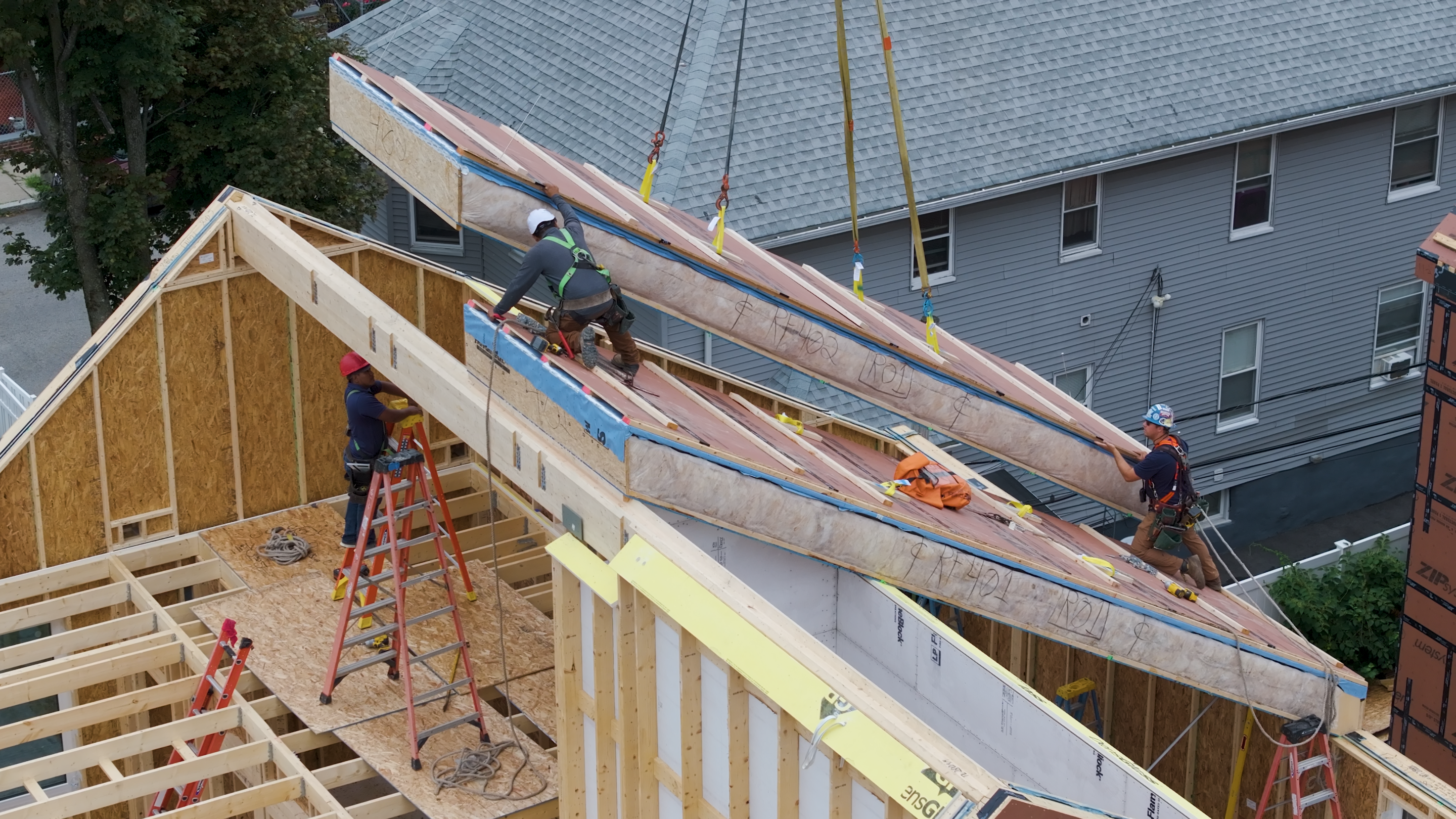
A crane lowers preassembled panels made by Keene-based Bensonwood into a home ownership development under construction in Boston. Photo by Peter Bowring | Courtesy of Dorchester Design Collaborative
Industry executives report growing interest in modular home construction as the state and region grapple with an acute housing shortage that seems to be getting worse by the season.
But will the interest in modular be enough to substantially ease the single-family and multifamily housing crunch that’s relentlessly driving up home prices across New Hampshire?
Experts aren’t sure about the impact of modular for a variety of reasons, including what some say is a lack of affordable land that’s holding up many housing projects across the state, modular and non-modular alike.
“Modular can certainly help in dealing with today’s housing crisis, but it’s the land and other factors that complicate things,” said Bruce Cudney, owner of New Hampshire Modular Homes, a modular dealer in Warner.
“We’re definitely seeing an uptick in inquiries,” agreed Seth Clarke, an architect and director of sales at Keene-based Bensonwood, an offsite-construction and panelization company. “But we’re encountering a lot of challenges associated with specific properties – high site costs, septic tanks, utilities, new driveways, zoning.”
Old Stigma Fading
As for the growing interest in modular in general, there are few statistics specifically tracking modular construction in New Hampshire.
But industry figures interviewed for this story say old and unfair stigmas about modular housing – such as that they’re flimsy and inferior in quality – have been slowly fading away as the design of modular homes have steadily improved over the decades.
Meanwhile, many cities and towns lately seem more amenable to modular construction, or variations of modular construction, as they attempt to address housing shortages in their communities.
Modular homes are also gaining in popularity, supporters say, because they’re faster to build than traditional stick-built houses – about six to nine months for modular versus a year or more for stick-built abodes.
Another advantage of modular: They aren’t as vulnerable to trade-industry labor shortages as on-site builders, depending on the geographic location of new homes.
Modular homes’ components are all built and assembled in off-site mini-factories where labor availability is more predictable and steady, industry officials say.
But modular homebuilders stress that, despite widespread assumptions, modular construction isn’t necessarily less expensive than traditional home construction.
“That’s one of the biggest myths that we have to deal with – that modular is much cheaper than stick-built,” said Cudney.
Others say that modular, or variations of modular, can indeed cost a bit less than traditionally built homes, perhaps by 5 percent or so.
But they agree that overall financial savings are not as great as many consumers think and hope.
Speed to Market a Selling Point
It’s the other advantages of modular – its faster build times, its more predictable factory-driven prices and its year-round available labor pool – that’s making modular a more attractive option for customers.
“It’s not a lot less expensive. It’s comparable in prices. But what it essentially saves is time. And it’s more convenient,” said Cudney.
Today, modular single-family homes remain more popular than multifamily modular residences.
Single-story, ranch-style homes in the 1,500-square-foot range remain the most requested type of modular housing, said Cudney.
But he noted his firm is seeing more demand for other types of modular single-family homes, such as 2-story, three-bedroom Colonials in the 2,000-square-foot range.
“They’re all different,” Cudney said of modular home styles and designs. “But they’re still mostly aimed at entry-level owners and seniors who want smaller homes.”
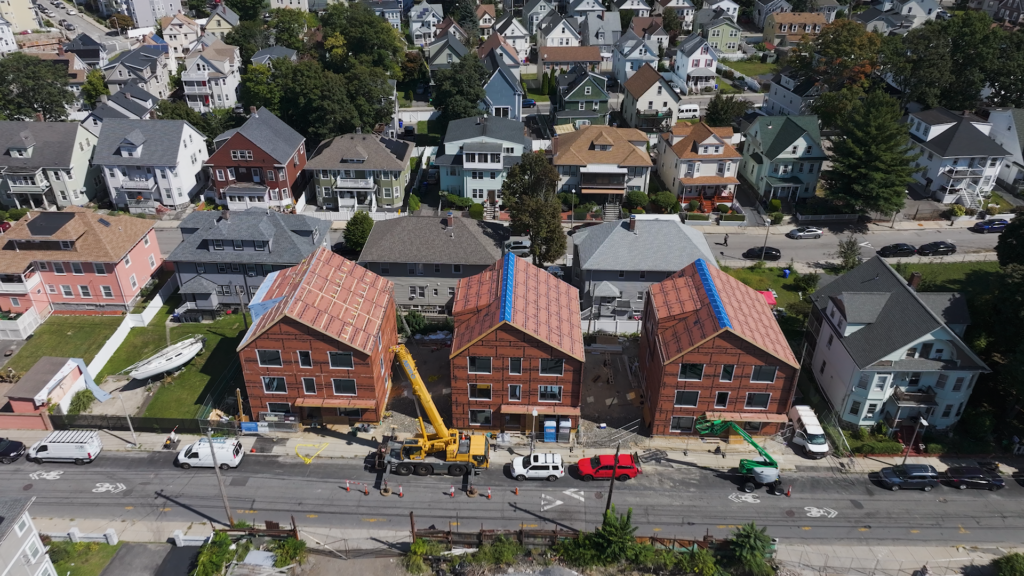
Bensonwood, a Keene-based maker of high-efficiency, panelized walls for residential construction, is one of several New Hampshire modular construction firms who say demand for their products and services is growing. Photo by Peter Bowring | Courtesy of Dorchester Design Collaborative
Fewer Modular Multifamilies
The demand for modular multifamily construction isn’t as great as single-family modular, industry executives say.
But that doesn’t mean demand for multifamily modular – particularly small two- to five-unit multifamily structures – hasn’t been growing of late.
Drew Pierce, president of Seacoast Modular Homes in Stratham, said his firm is in the planning stages to build four duplexes in Stratham for a private developer.
Each of the eight townhouse-like units will be 1,500 square feet in size and have a garage, he notes.
Because Seacoast Modular hasn’t built many multifamily modular units in the past in New Hampshire, Pierce said, he’s hoping the Stratham project will lead to more multifamily modular business for his firm.
“After we finish building [the duplex project], we plan to market it” to see if others are interested in multifamily modular, he said.
Bensonwood’s Clarke said his firm — which specializes in building super-energy efficient, panelized exterior walls of homes at its factory in Keene – has previously constructed multifamily homes in Massachusetts and New York.
Demand for ‘Missing Middle’ Buildings
But now Bensonwood is starting to field calls for multifamily work in New Hampshire, he said.
Locally, developers who approach Bensonwood are more interested in smaller multi-unit structures, in the two- to four-unit range, Clarke said.
“There’s a bigger interest in small multifamily [structures],” he said. “Larger multifamily are seen as being out-of-character in my towns.”
But duplexes and triplex homes are viewed as more acceptable because they not as architecturally out of place.
“They’re filling that ‘missing middle’ of affordable housing,” Clarke said of small multifamily structures.
Despite all the pluses of modular construction, modular projects nevertheless face many of the same obstacles as traditionally built structures: zoning rules, NIMBY opposition, high construction costs and, last but not least, the availability of affordable and buildable land.
“Some lots are just hard to build on,” said Clarke. “Site costs are a big challenge for everyone.”