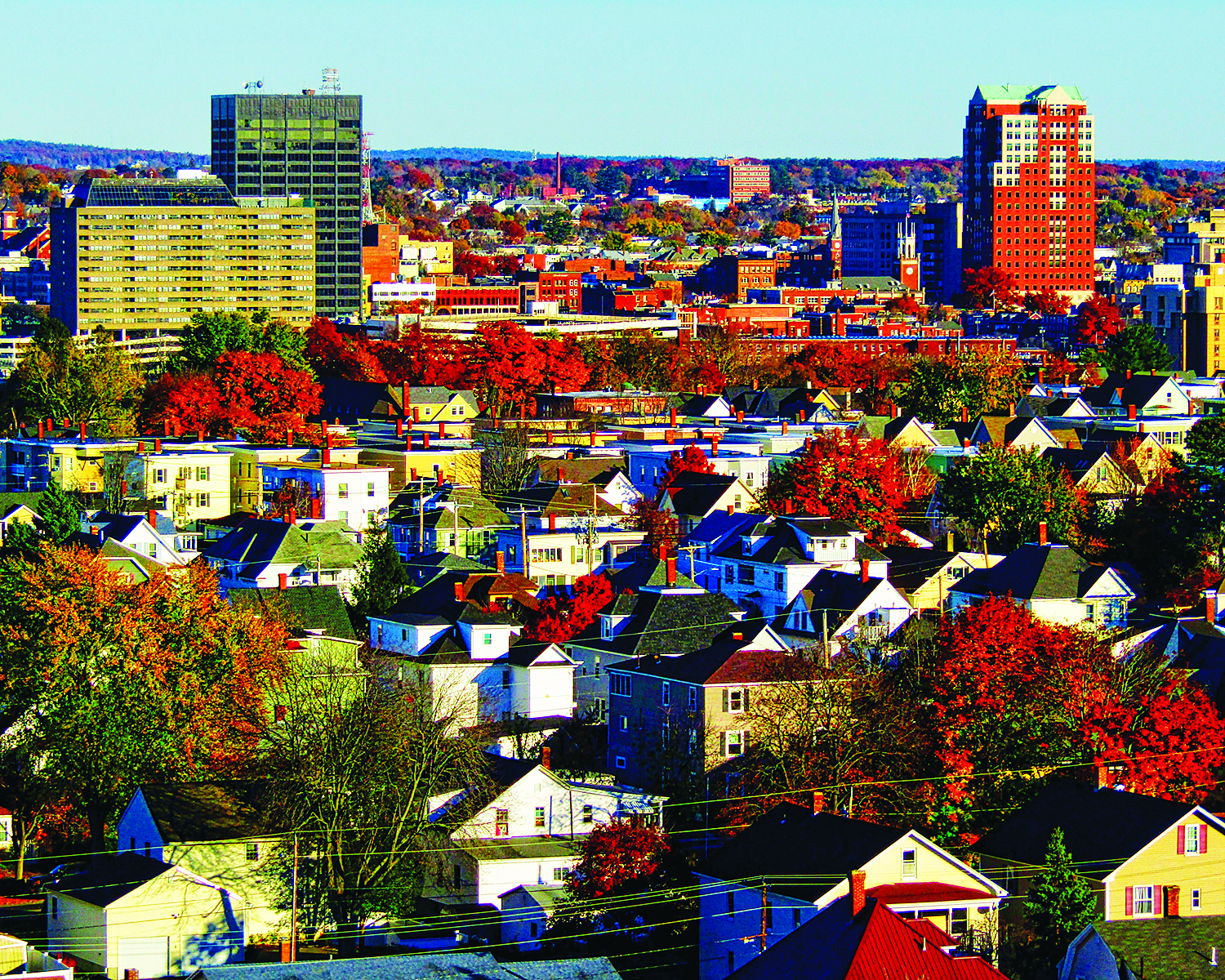
Southern New Hampshire University will soon list its 130,000-square-foot office building and nearby parking lot in Manchester’s Millyard neighborhood. iStock photo
The guessing game has begun. Southern New Hampshire University’s recent confirmation that it plans to vacate and sell off its major holdings in Manchester’s Millyard has sparked speculation about what comes next for the prime properties and the city’s downtown in general.
Industry speculation over future uses of the school’s 130,000-square-foot office building at 55 South Commercial St. range from it remaining offices to its eventual conversion into residential housing.
Inventor and major Millyard property owner Dean Kamen hope it can be converted into tech-related R&D and manufacturing space, complementing the Millyard’s growing list of biomanufacturing and bio-fabrication tenants.
“If it can be broken up into a lot of startup opportunities that can scale up biotech, that would be great,” said Kamen, chief executive of Millyard-based DEKA Research & Development Corp. “I’m hoping it will become a very attractive place to bring in new biotech companies.”
The worst-case scenario for the property, as some observers see it: that the office building, along with SNHU’s recently built 1,700-space parking garage at 75 South Commercial St., remains largely empty for years, unable to quickly adapt to changing real estate and economic times in the city.
“It will eventually find new uses,” said Michael Harrington, owner of Harrington & Co., a commercial real estate firm, of SNHU’s Millyard office building in particular. “I honestly don’t know what might go in there. Maybe a repositioning of some sort? It’s going to happen. But it just may take a while.”
Manchester’s Director of Economic Development Jodie Nazaka expressed confidence that SNHU’s office building and coveted parking garage will probably find a new owner – and potential new uses – sooner rather than later.
“We’ve had a number of (people) expressing interest in the property,” said Nazaka, who didn’t mention any names. “I have no doubt the office building will be bought and put to use. It’s a beautiful building with a beautiful new garage.”
She said the city would prefer that the main building remain commercial, whether as offices, some sort of R&D/advanced manufacturing space, or a combination of the two.
A mixed-use future – including any combination of commercial, retail, entertainment and residential components – would also be welcome, she added.
Post-Pandemic Adjustments
Earlier this summer, SNHU confirmed it plans to vacate and sell off its Millyard properties, as part of ongoing efforts to consolidate all office and other operations on its 300-acre main campus, which straddles the Manchester-Hooksett border to the north.
Known for the explosive growth of its online educational offerings over recent decades, SNHU has said much of its administrative and office staff permanently shifted to either remote or “hybrid” work following the Covid outbreak in 2020, lessening the university’s overall need for office space in general.
Today, only about 300 “hybrid” employees – or those splitting their work time between home and offices – are now based out of the Commercial Street building, down from a high of about 1,800 full-time employees in 2019, according to the city.
SNHU has not set a timeline for the sale of the building and its parking garage.
But a SNHU spokeswoman told The Registry Review in an email that the Millyard holdings have “not yet been formally listed for sale but [are] expected to be in the next month or so.”
Nazaka said her belief is that a final sale may not happen until next year.
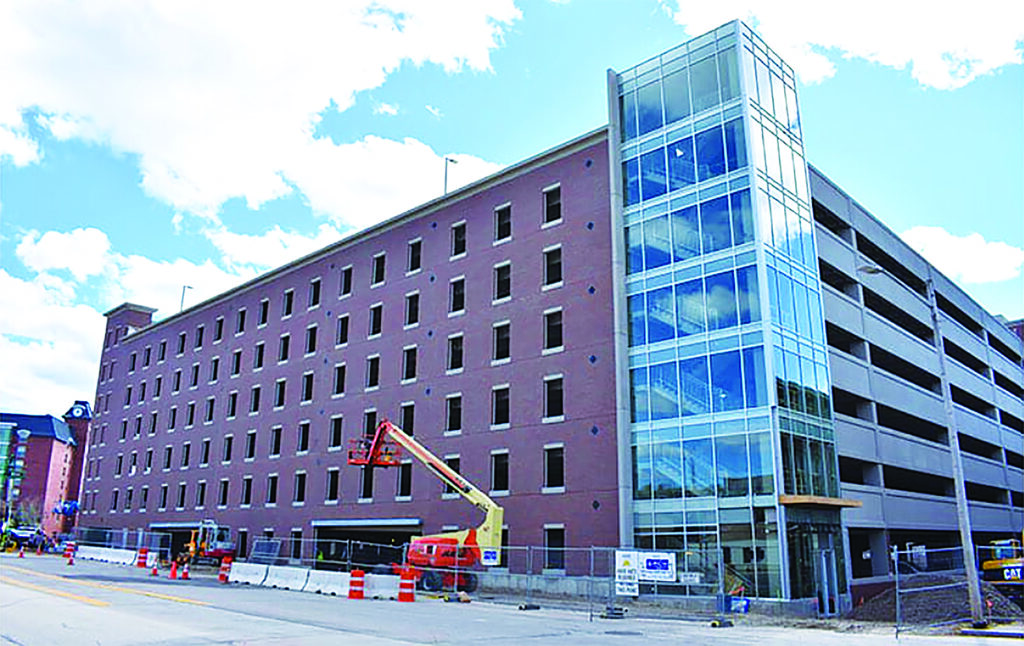
SNHU’s 1,700-space parking garage opened in July 2019. Image courtesy of TF Moran.
Office to Residential Speculation
Because SNHU has already slashed the number of its employees at the Millyard in recent years, most officials believe the city’s office market won’t suffer too much with the loss of the university’s remaining 300 “hybrid” workers.
But SNHU’s Millyard departure would still leave a large 130,000-square-foot hole in the office market – and at a time when Manchester is still adjusting to the long-term effects of remote work.
The rise of remote work didn’t hurt Manchester’s downtown district nearly as hard as office markets in other U.S. cities, such as Boston, where the office vacancy rate still hovers above 20 percent.
Still, Manchester’s vacancy rate did soar as high as 14 percent after the 2020 Covid outbreak – and only recently has the rate fallen to around 5.6 percent or 7.9 percent, according to data from Cushman & Wakefield and Colliers International, respectively.
Both of those numbers are considerably below the statewide office vacancy rate that’s now hovering between 10 and 11 percent, according to data.
Manchester’s office market has steadily improved over recent quarters partly due to the state’s strong economy. It has also been helped by major office-to-residential conversion projects in recent years, such as Brady Sullivan Properties’s conversions of office buildings at 1000 Elm St. and 1230 Elm St. into hundreds of new apartment units.
Those and other successful office-to-residential conversions have led some industry officials to speculate that SNHU’s property is probably destined for the same fate.
“I think it’s going to go residential,” said Roger Dieker, managing broker of the Manchester office of commercial real estate firm Boulos Co. “It’s a big chunk of space with an attractive parking garage, so I can see it being converted to residential.”
Such speculation has led to the obvious question: Might Brady Sullivan itself buy 55 S. Commercial?
Not only has Brady Sullivan converted office buildings into housing in the Millyard and elsewhere, it also recently announced plans to convert about one third of the former Liberty Mutual office campus in Dover into housing.
Officials at Brady Sullivan couldn’t be reached for comment.
Another potential buyer being mentioned: Dean Kamen, whose DEKA and other affiliated companies take up huge swaths of space in the Millyard. Kamen is also cofounder of the nonprofit Advanced Regenerative Manufacturing Institute (ARMI), whose mission is to nurture “bioeconomy” initiatives in New Hampshire.
Kamen said he’s not personally interested in buying the property and its coveted 1,700-space parking garage. ARMI is not in the position to buy the property, he added.
Growth in Retail and Residential
Matthew Lefebvre, principal broker at Downtown Realty, said that Manchester’s downtown district is strong enough to withstand any hit from SNHU’s planned departure from the Millyard.
“They’ve been downsizing there for years,” he said of SNHU. “In terms of immediate impact, SNHU leaving is next to nothing.”
In particular, the downtown’s retail market has strengthened in recent years due to the opening of a number of new shops and eateries, including Harpoon’s recently opened 9,100-square-foot brewery and restaurant at 215 Canal Street.
Meanwhile, the city’s downtown has seen the recent construction of the new 77-unit Grand Central Suites apartment complex at 21 Central St. and the opening two years ago of the new 250-unit 75 Canal St., Lefebvre noted.
“We’ve seen a lot of good things happening in Manchester,” Lefebvre said. “I think downtown Manchester has a lot of room for growth, with or without SNHU.”
Dieker agreed that Manchester is in a good position for growth.
“The word is out: Manchester is open for business,” he said.